

Three ways to accept stablecoin payments: choosing the right integration for your business
Learn how to accept stablecoin payments with three integration options, including website modules, Stripe crypto integration, and QR codes.
Adding a new payment method shouldn't mean a six-month engineering project. But it also shouldn't mean bolting something on that creates friction right at the moment a customer is ready to pay.
MNEE Pay gives merchants three ways to start accepting stablecoin payments as part of a modern crypto payment system. Each one is built for a different technical setup, sales environment, and level of integration investment. If you haven't yet read up on what a stablecoin payment actually is, that's worth five minutes before you dig in here.
Here's how each option works, and what to think about before you choose.
Option 1: the embeddable payment module
This is the most direct path for merchants who want stablecoin payments on their own website. Inside your MNEE Pay dashboard, you create a payment module and configure it for your use case. That might be a checkout button, a donation widget, or a paywall. The dashboard generates a lightweight code snippet. You drop it into your site.
When a customer clicks the button, they connect their crypto wallet, choose a stablecoin, and confirm the transaction. The payment converts to MNEE and settles into your merchant wallet in real time.
This option works well if you:
- Run your own website and have basic access to edit the code
- Want a checkout experience that lives on your own domain
- Don't use Stripe, or prefer an integration that doesn't depend on a third-party processor
- Sell digital goods, run subscriptions, accept donations, or operate a paywall
What to expect:
The technical lift is minimal. You're copying and pasting a snippet, not building an integration from scratch. No blockchain knowledge required.
Option 2: the Stripe integration
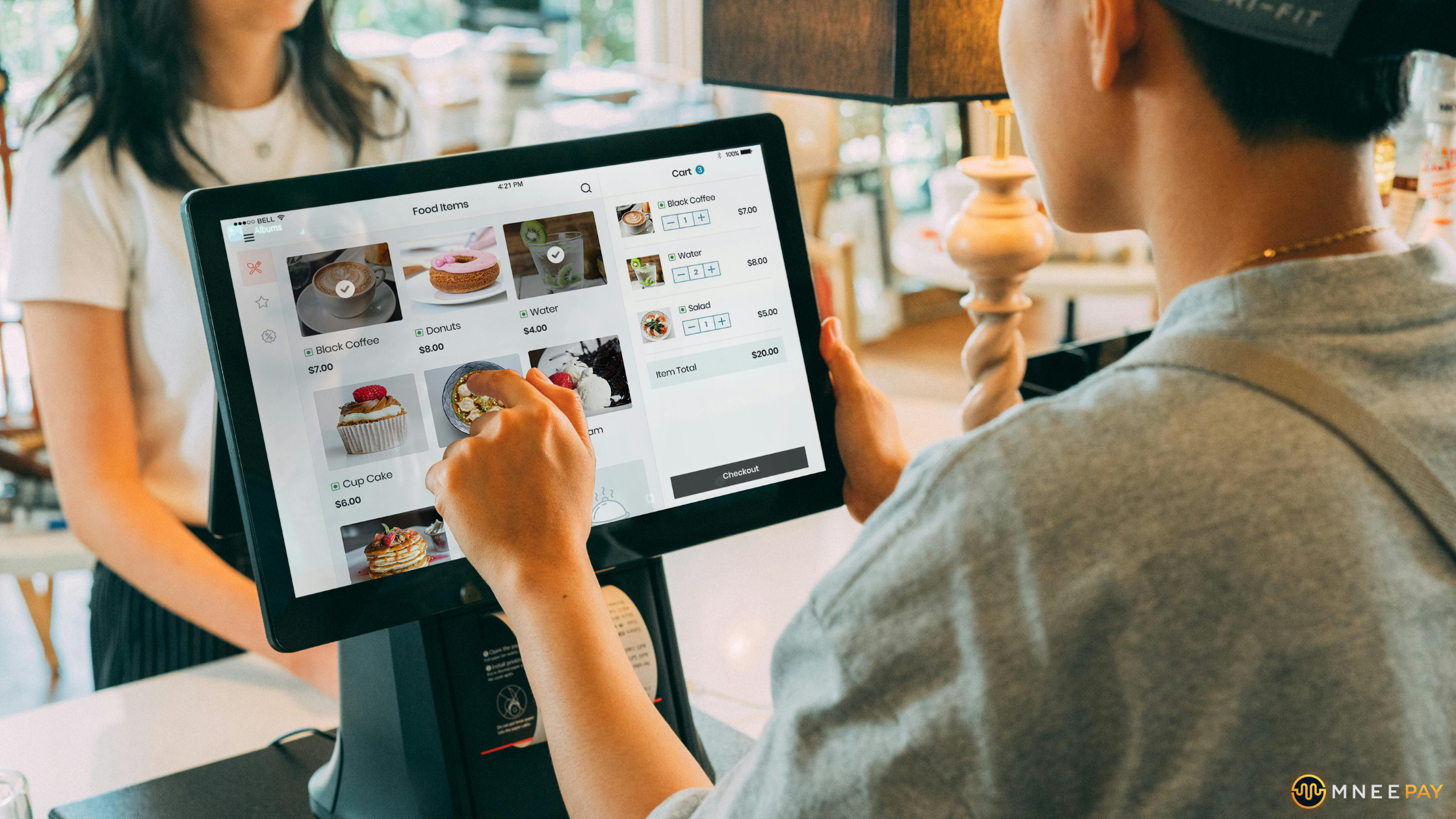
For merchants already running on Stripe, MNEE Pay can be added as a Stripe crypto payment option directly within your existing checkout flow. Setup happens inside your MNEE Pay dashboard through a one-time configuration. Once it's live, customers can choose MNEE Pay at checkout and complete their payment using their crypto wallet. On the back end, Stripe's standard fulfillment workflows fire as normal, including receipts, shipping notifications, and any downstream automations you already have running.
This option works well if you:
- Already use Stripe as your primary processor
- Want MNEE Pay to connect cleanly to your existing fulfillment and reporting workflows
- Need Stripe-side receipts and order confirmations to fire automatically
- Have a developer available for the initial configuration
What to expect:
Setup requires a one-time configuration across your Stripe account and your MNEE Pay dashboard. Once done, it runs alongside everything else you already have in place.
Option 3: the standalone QR code
The fastest path to accepting stablecoin payments with no code changes required. Your MNEE Pay dashboard generates a QR code tied to your merchant wallet. You can display it on screen, download it as a PNG, or print it for use at a physical point of sale.
Customers scan it with their crypto wallet app and send payment directly to your receive address. Funds settle into your MNEE Pay wallet.
This option works well if you:
- Operate a physical retail environment, market stall, or event setting
- Want to start accepting stablecoin payments right now with no technical setup
- Are piloting stablecoin payments before committing to a deeper integration
A few things to note:
The QR code is amountless, meaning no transaction value is pre-set. You'll confirm the amount with the customer before they scan. There's also no real-time confirmation notification in the current version, so you'll want to verify receipt in your dashboard before completing the sale.
How to choose
The three options aren't mutually exclusive. Plenty of merchants start with the standalone QR to test demand, then layer in the embeddable module or Stripe integration once volume justifies the setup time.
If you run an e-commerce site and want stablecoin payments to feel native to your checkout, the embeddable module is the most direct path. If your business runs on Stripe and you want your existing workflows to stay intact, go with the Stripe integration. If you want to accept payments by end of day with no engineering work, start with the QR code.
The underlying economics are the same across all three: 0.99% + $0.05 per transaction, real-time settlement, and no chargeback exposure. The integration is just how you get there.
MNEE Pay is built on a compliance-first infrastructure, with business verification through Sumsub, passkey authentication as the default login method, and backend enforcement of all compliance controls. Book a demo.
Chelsea Lai
Chelsea Lai is a Growth Marketing Manager focused on the intersection of stablecoins, crypto payments, and real-world business adoption. Her work is centered on breaking down complex concepts like blockchain payments and digital assets into clear, practical insights that merchants can actually use. She’s particularly interested in how stablecoin payments are reshaping global commerce by reducing friction, lowering costs, and making cross-border transactions more seamless.