

7 Ways to Reduce E-Commerce Payment Processing Fees in 2026
Card fees stack up in layers most merchants never see broken out. Here's where those layers come from, seven ways to bring your effective rate down, and how a flat-rate stablecoin checkout option compares on a real transaction.
Every card swipe or online checkout carries a cost most business owners never see broken out on their P&L. Run $50,000 through your store in a typical month at a 3% effective rate, and $1,500 of that revenue disappears before you've paid for anything else. If you're looking for ways to reduce e-commerce payment processing fees, you're not chasing a rounding error. You're protecting a margin that's already thin.
This guide walks through where those fees actually come from, seven practical ways to bring them down, and a newer option a growing number of merchants are adding alongside the cards they already accept: flat-rate stablecoin checkout. By the end, you'll know what to check on your next statement and what a lower-fee setup could look like for your business.
Why Your Credit Card Processing Fees Are Higher Than You Think
Most merchants think of their processing fee as a single number on a statement. It isn't. Every card transaction actually gets charged three times over: an interchange fee that goes to the bank that issued the card, an assessment fee the network takes (Visa, Mastercard, and so on), and a markup your processor adds on top for itself. Add all three together and you get your effective rate, which is the number that actually tells you something.
Online and keyed-in transactions carry a higher effective rate than in-person sales, largely because card-not-present transactions carry more fraud risk for the issuing bank and get priced accordingly. According to research from The Motley Fool, the average effective rate for online and keyed transactions in 2025 was 2.31% plus $0.25 per transaction, with Visa and Mastercard's combined average interchange rate reaching 2.36%. On a $75 order, that's roughly $1.98 gone before you've covered shipping, packaging, or anything else that keeps your business running.
If your margins are tighter than that, credit card processing fees aren't a line item you glance past. They're a direct cut out of what you take home.
How to Calculate What You're Actually Paying in Processing Fees
Before you can reduce e-commerce payment processing fees, you need an honest number to start from, not the "as low as" rate your processor advertised at signup.
The Effective Rate Formula
The math is simple. Add up every fee you paid in a given month (processing fees, monthly fees, PCI fees, chargeback fees) and divide that total by your total card sales volume for the same period. Multiply by 100, and that's your real, effective rate.
Total fees paid ÷ total card sales volume × 100 = effective rate
Pull this from an actual statement, not a sales pitch. Processors rarely lead with the blended rate, because it tells a less flattering story than the number on the welcome email.
The Hidden Fees That Inflate Your Statement
A handful of charges rarely show up until you go looking for them:
- PCI compliance fees: charged monthly if you haven't completed your Self-Assessment Questionnaire. The PCI Security Standards Council sets the underlying data security standard; your processor sets and collects the actual fee.
- Batch fees: charged each time you close out and settle a day's transactions.
- Downgrade fees: triggered when a transaction misses the criteria for the lowest interchange tier, often something as small as a missing address verification field.
- Chargeback fees: charged on top of the disputed amount itself, whether you win the dispute or not.
Any one of these can push your real rate a half point or more above what you were quoted when you signed up.
7 Ways to Reduce E-Commerce Payment Processing Fees
Once you know your real number, here's where to go after it.
1. Audit your last three statements line by line
Pull the actual PDFs, not the summary email your processor sends. Look for downgrades, batch fees, and any line you can't explain in one sentence. A proper statement audit routinely turns up charges merchants didn't know they were paying.
2. Move to interchange-plus pricing
If you're on a flat "tiered" plan, ask your processor about interchange-plus pricing instead. It separates the interchange fee, which you can't negotiate, from the processor's markup, which you can. Once you can see the two apart, you know exactly which piece to push back on.
3. Cut chargebacks before they cut you
Chargebacks cost far more than the disputed amount alone. Mastercard's research puts the average combined cost of a chargeback at $128 across internal handling and third-party fees, before you even count the goods or services already delivered. Clear return policies, billing descriptors that match your storefront name, and fast responses to disputes all bring that number down.
4. Use Level 2 and Level 3 data on B2B transactions
If you sell to other businesses, submitting extra data with each transaction, things like purchase order numbers, tax amounts, and line-item detail, can qualify the sale for a lower interchange tier. A lot of merchants never turn this on simply because their payment gateway doesn't surface the option by default.
5. Batch and settle correctly, every day
Settling your batch outside the window your processor allows (usually 24 hours) can bump every transaction in that batch into a more expensive, downgraded tier. It's a small operational habit, and an easy one to lose track of during a busy week.
6. Consolidate processors to negotiate from strength
Splitting volume across two or three processors to "diversify" often means none of them see enough of your business to offer their best rate. Consolidating volume with a single processor gives you real leverage at renewal time.
7. Add a payment rail that skips interchange entirely
None of the six steps above touch the interchange fee itself, because interchange is set by the card networks, not your processor. The one lever that changes the math completely is offering a payment method that never enters the interchange system in the first place. That's where stablecoin checkout comes in.
Why More Merchants Are Adding Stablecoin Payments to Cut Fees
Point seven is worth its own section, because it works differently from the six before it. A stablecoin payment settles directly between buyer and merchant, so it skips the interchange and assessment fees a card transaction is built to carry. That's a structural difference in how the payment moves, not a temporary discount.
What a Stablecoin Payment Actually Costs
MNEE Pay charges a flat 0.99% + $0.05 per transaction, deducted automatically at settlement. No interchange stack, no downgrade risk, no batch fees layered on top. Run the same $1,000 sale through both systems: a typical card effective rate of 2.9% + $0.30 comes to $29.30, while MNEE Pay comes to $9.95. That's a difference of $19.35, or almost 66% less, on one transaction alone.
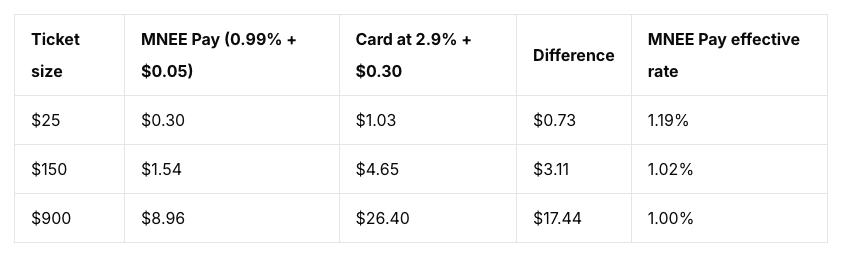
That gap remains as it is whether you're processing $10,000 a month or $1 million, because the rate never shifts based on your volume, your industry, or how an underwriter categorizes your business. If you want to see the math against your own numbers, MNEE Pay's fee calculator runs the comparison for you.
How It Works Without Disrupting Your Existing Checkout
You don't need to rebuild your checkout to add this. MNEE Pay plugs into the Stripe setup you already have, so it just sits next to the cards you're already taking instead of replacing them. Buyers choose it as one more option at checkout, the same way they'd choose a card or a digital wallet today.
On the buyer's side, MNEE Pay supports multi-token checkout across 14 stablecoin and network combinations, starting with USDC and MNEE. There's no bridging or swapping required. Buyers pay with whatever stablecoin they hold, and it settles cleanly on your end.
What You Get Beyond the Fee Savings
Lower fees are the headline, but the mechanics around them matter too. You can issue a full or partial refund directly from the Merchant Portal, and funds return to the buyer's wallet automatically, the same way a card refund posts back to a customer's statement. Buyers get a branded receipt with transaction details for every purchase. And on your end, you can convert your MNEE balance and withdraw to USDC or USDT on Ethereum directly from the Merchant Portal whenever it suits your treasury.
Is Switching Worth It? What to Weigh First
Who's Actually Paying This Way Today
Crypto-familiar buyers and international customers tend to be the first to use stablecoin checkout, since it lets them pay without a currency conversion step. If most of your customers have never held a stablecoin, this won't replace your card volume overnight, and it doesn't need to. It's an added option next to your existing checkout, so there's no downside to turning it on for the customers who do want it.
Verification Protects You, Not Just Compliance
Before you can accept stablecoin payments, we verify your business through a process known as KYB (know your business). It can feel like one more form to fill out, but it exists for the same reason bank verification exists in traditional finance: to keep your account, and your buyers, protected from the kind of fraud those checks are designed to catch. Think of it as protection you're glad to have, not paperwork for its own sake.
How to Start Accepting Stablecoin Payments Alongside Cards
Getting set up takes three steps:
- Create your Merchant Portal account. Sign-up is self-serve, and you don't need a development team involved for the initial setup.
- Connect your existing Stripe integration. MNEE Pay layers on top of what you already have, so your current checkout flow doesn't change for customers who keep paying by card.
- Turn on multi-token checkout. Once you're verified, buyers see the stablecoin option at checkout immediately, and every payment method you already offer keeps working exactly as it did before.
The Bottom Line
Processing fees aren't as fixed as most merchants assume. Between auditing your statement, moving to interchange-plus pricing, cutting chargebacks, and adding a flat-rate stablecoin option, most businesses have real room to reduce e-commerce payment processing fees this quarter, not sometime next year. Start with your last three statements, run the math, and see where your fastest win actually is.
Ready to see it against your own numbers? Book a demo with our team, or go create your Merchant Portal account and add stablecoin checkout right next to the payment methods you're already using.
FAQ
What does it cost to accept stablecoin payments for e-commerce?
A flat 0.99% + $0.05 per transaction, deducted automatically at settlement. There are no tiers and no monthly minimum. On a $100 sale the fee is $1.04, so $98.96 lands in your Merchant Portal. The amount that arrives is already net, so there is no separate invoice to reconcile against your payouts.
Do I have to replace my current checkout or payment gateway?
No. MNEE Pay runs alongside the payment methods you already offer and works with existing gateways, including Stripe, through a self-serve setup in the Merchant Portal. It is an added payment rail, not a migration. Your current checkout keeps running exactly as it does now.
Which stablecoins can buyers pay with?
Buyers can pay with 14 stablecoin and network combinations, starting with USDC and MNEE, with no bridging or swapping needed. They pay in the token they already hold, from the wallet they already use, and the payment is received at stable value. MNEE is a stablecoin always worth $1 USD, so a $100 order is a $100 order.
How do refunds and chargebacks work?
You issue a full or partial refund directly from your portal, and the funds return to the buyer's wallet automatically. On-chain payments settle with finality, so a buyer cannot file a bank chargeback the way they can with a card. That removes a common source of fraudulent reversals, while refunds stay fully in your control.
How does this reconcile at the end of the day?
Every payment produces an on-chain record and a branded buyer receipt, both visible in your portal. A day of stablecoin sales reads like any other settled batch: each transaction shows an amount, a fee, and a net figure that already matches what landed. When you want to move a balance, convert your MNEE balance and withdraw to USDC or USDT on Ethereum directly from the portal.
Do I have to verify my business before I can accept payments?
Yes, and it works in your favor. We verify your business before you go live, which protects you and your buyers by keeping bad actors out of the network. It is a one-time step, not an ongoing hurdle. From there the path is short: verify your business, connect MNEE Pay to your stack, and accept your first stablecoin payment.