
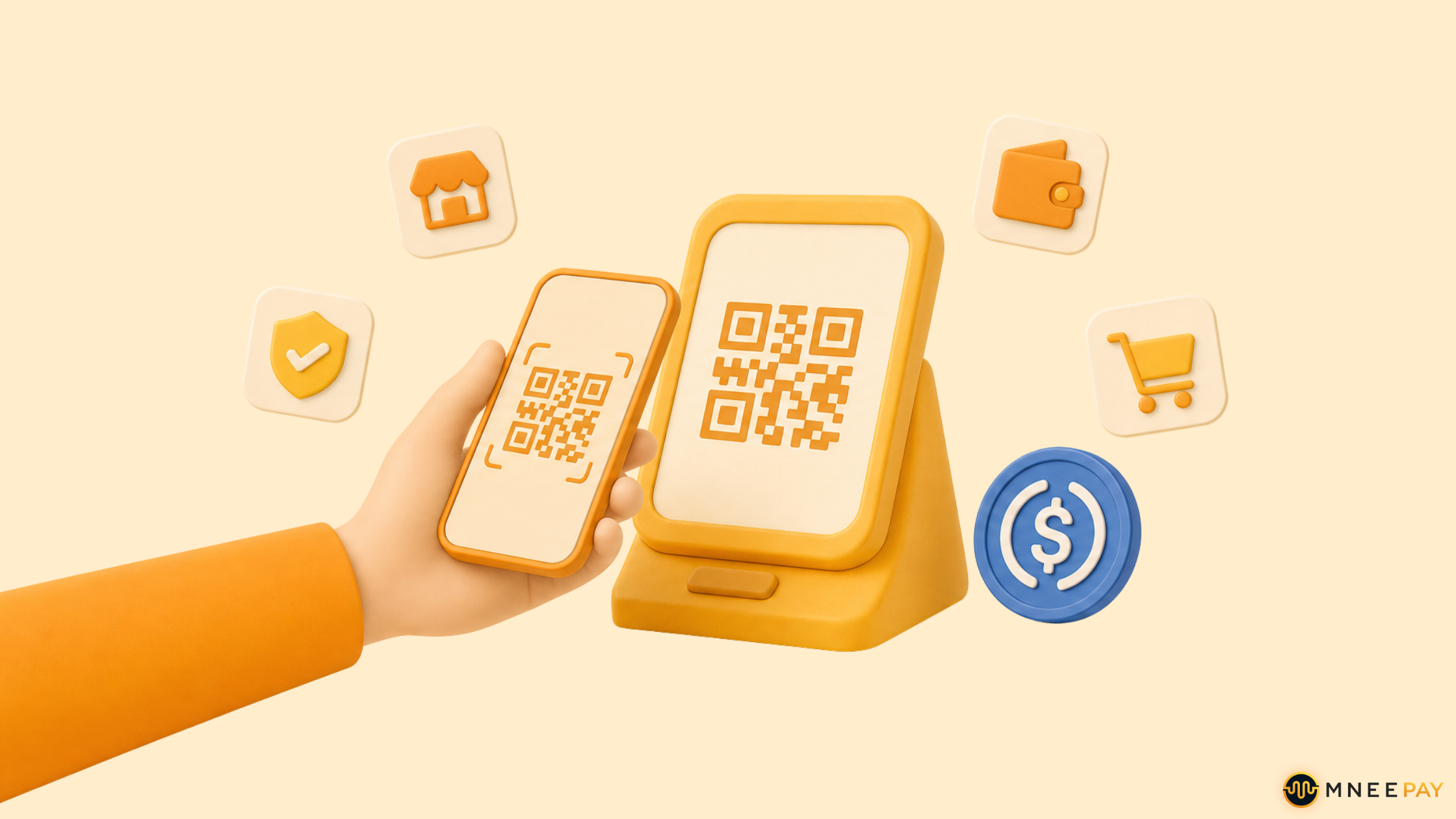
How to Accept Stablecoin Payments In Store with QR Codes
A customer at your counter can pay in stablecoin by scanning a code on their phone, and you're settled before they leave. Here's how to set it up on the POS you already use, what it costs, and how the money reaches your bank.
A customer reaches your register, opens their phone, scans a code, and pays. You're settled before they've picked up their bag, and the value you received holds at a dollar. That's what it looks like to accept stablecoin payments in store, and it runs on the point-of-sale system you already own. No new hardware to buy.
The reason to bother is margin. Card processing takes a variable cut of every sale and holds your money for a few days before it clears. Stablecoin acceptance through MNEE Pay costs a flat 0.99% + $0.05 per transaction and settles on the spot.
This guide walks through what in-store stablecoin acceptance actually involves, how to set it up, what it costs down to the cent, and how to handle the things that come up at a real counter, like returns and receipts.
What accepting stablecoin payments in store actually means
Stablecoins are a type of cryptocurrency designed to maintain a stable value by pegging to fiat currencies. Think of stablecoin like a digital dollar. One unit is always worth $1 USD, so the value of a payment doesn't drift between the sale and the settlement. A $40 sale is worth $40 when it lands. That's the whole point of the peg, and it's what separates stablecoins from the crypto that swings overnight.
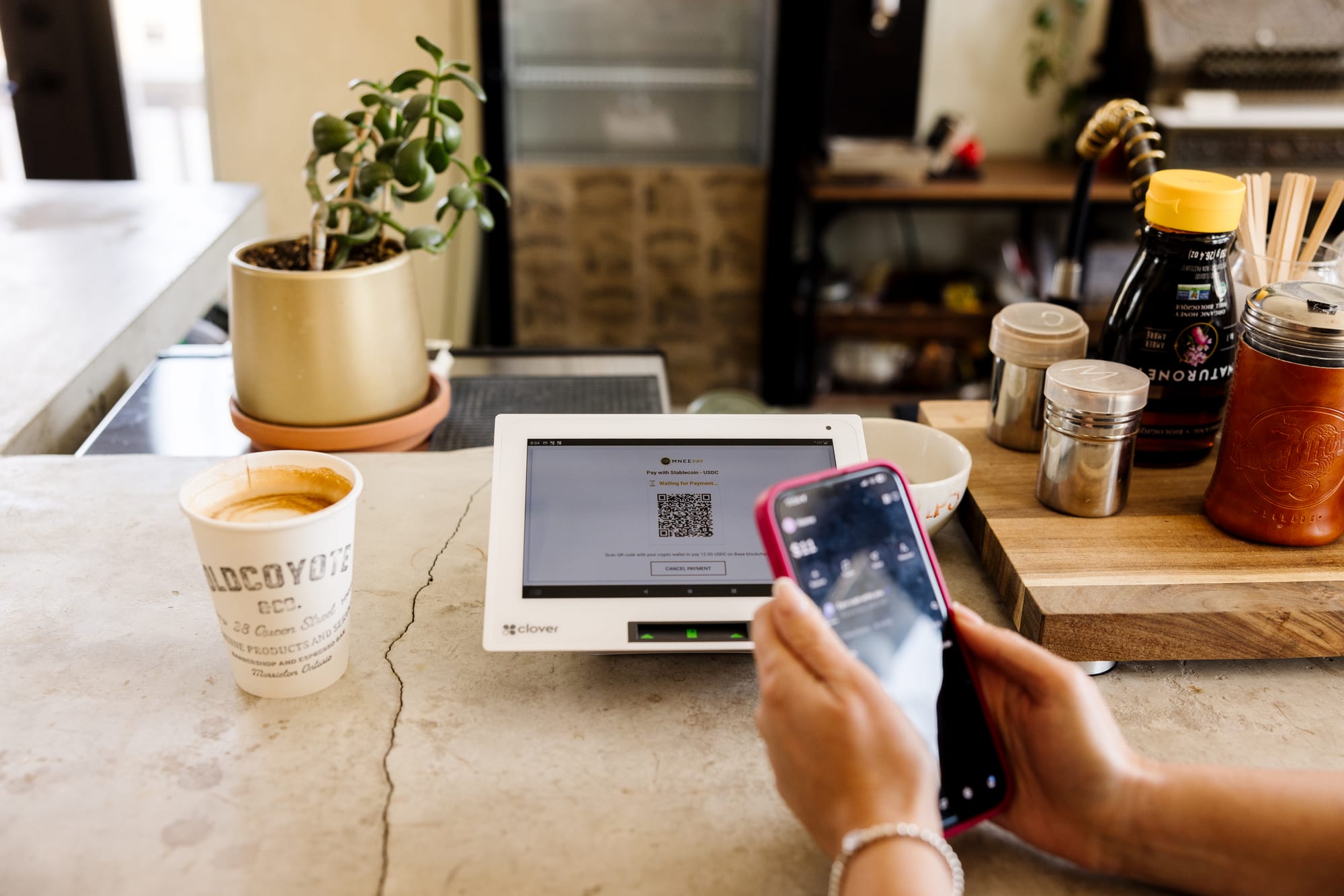
In store, the mechanics are simpler than card rails. MNEE Pay adds a custom tender type to your existing POS, sitting alongside the "cash" and "card" options you already ring up. When a customer wants to pay in stablecoin, they select the "Pay with stablecoin" option and the screen shows them a QR code. They scan it, confirm in their own wallet, and the payment settles instantly. Nothing gets swiped, and there's no terminal to lease.
In-store stablecoin acceptance lets a customer pay with a digital dollar at your physical register by scanning a QR code on their phone. The payment settles instantly at a fixed value and runs as a custom tender type on your existing POS, with no new hardware required.
Customers pay with whatever they hold. MNEE Pay accepts USDC and USDT across 14 stablecoin and network combinations, so there's nothing for the person at your counter to bridge or swap first.
Why retailers accept stablecoin payments in store
Start with the fee, because that's usually what tips the decision. Card processing typically runs around 2.9% plus a per-transaction charge, and that cost scales with every sale. MNEE Pay is a flat 0.99% + $0.05. Against card processing near 2.9%, that works out to roughly 60 to 80% less on the cost of getting paid.
The fee isn't the only thing that matters at a physical store, though. Because stablecoins are pegged to the dollar, you're not carrying any crypto volatility. What you charge is what you keep. Settlement is instant, so you're paid before the customer walks out rather than waiting the usual few business days for card money to clear. And since MNEE Pay works as a tender type on any POS, there's nothing to install at the register beyond a screen to show the code.
You don't have to take the comparison on faith. Run your own volume through the merchant fee savings calculator and see what your current processing would cost on a flat 0.99% + $0.05.
What you need before you start
The setup is light. You need a verified MNEE Pay merchant account, a way to display the QR code at the counter (a phone, tablet, or screen you already have works), or your existing POS. You don't replace your system; MNEE Pay slots in as a tender option.
Business verification, sometimes called KYB or Know Your Business, is the one step worth understanding rather than dreading. We verify your business before you go live because it protects you and your customers, and because it's part of operating on regulated infrastructure. MNEE Pay runs on SOC 2 Type II and ISO 27001 controls as a FinCEN-registered money services business, with GENIUS Act compliance built in. Verification is what keeps that foundation sound.
How to accept stablecoin payments in store with QR codes: step by step
Here's the full flow, from signing up to handing over the receipt.
- Create and verify your merchant account. Sign up for MNEE Pay, complete business verification, and get approved to go live.
- Add MNEE Pay as a tender type on your POS. Set it up as a custom payment option on the system you already run. No new hardware, and it works on any POS.
- Ring up the sale and show the QR code. Enter the sale as usual, select the MNEE Pay tender, and display the code for the customer to scan.
- The customer scans and pays. They scan with their phone, pick their preferred stablecoin and wallet, and confirm. Nothing to bridge or swap on their end.
- Get paid instantly and hand over the receipt. The payment settles on the spot, so you're paid before they leave. The customer automatically gets a branded receipt with the transaction details.
For a busy store, step five is the one that counts. The sale is final and settled before the next person steps up.
What it costs and how settlement works
Pricing is one number: a flat 0.99% + $0.05 per transaction. No tiers, and no surprise charges tied to card type.
Here's the math on two everyday sales.
- On a $50 sale, 0.99% is $0.50, plus $0.05, so the fee is $0.55 and you keep $49.45.
- On a $500 sale, 0.99% is $4.95, plus $0.05, so the fee is $5.00 and you keep $495.00. Card processing near 2.9% plus a per-transaction fee would take closer to $14.80 on that same $500 sale.
The difference stays in your pocket.
Settlement is instant, and the money reaches you without any crypto housekeeping. Whichever stablecoin the customer used, the payment converts automatically into a single MNEE balance. From there you decide what to do with it: withdraw to your bank account, swap to other crypto, or hold the balance to earn rewards. Your team never touches wallets, keys, or on-chain operations.
Handling refunds and returns at the counter
Returns are the first thing most owners ask about, and the answer is simple. You issue a full or partial refund straight from your portal, with no separate tool and no manual crypto handling. The payment goes back to the customer's wallet.
Because the refund runs through the portal instead of a third-party terminal, the original sale and the reversal live in one place. That makes end-of-day reconciliation less of a chore.
Is accepting stablecoin in store right for your business?
Stablecoin acceptance isn't a replacement for your card reader. It's a cost-effective option that sits next to it, and it pays off fastest in a few situations. If you already serve crypto-comfortable customers, they'll reach for it without prompting and you save on every one of those sales. If you take cross-border or tourist traffic, stablecoins settle the same way no matter where the customer is from, which cuts out the currency friction. And if your category carries heavy card fees, a flat 0.99% + $0.05 changes the arithmetic in your favor.
If most of your customers will never open a crypto wallet, card and cash will still carry the bulk of your volume, and that's fine. Adding stablecoin as a tender type costs nothing at the register and gives the customers who want it, a way to pay while trimming your fees on those sales. It's an option to offer along with your existing system, not a complete system change.
Get started
In-store stablecoin acceptance comes down to three things: a verified account, a tender type on the POS you already run, and a QR code your customer scans. What you get back is a flat 0.99% + $0.05 per sale, instant settlement, and value that holds at a dollar.
Book a demo and we'll walk you through it step-by-step.
FAQ
Do customers need a specific app to pay in store?
No. Customers pay from their own wallet with the stablecoin they already hold. They scan your QR code, confirm in whatever wallet they use, and the payment settles. No dedicated app on their side.
Do I have to worry about price volatility if I accept stablecoins?
No. Stablecoins like USDC, USDT, and MNEE are always worth one US dollar. A $100 USD sale settles as $100 USD of value, so the amount does not move between checkout and settlement the way a volatile asset would.
Which stablecoins can customers pay with?
Customers can pay with USDC, USDT, MNEE, and more, across 14 stablecoin and network combinations. Whatever they pay with converts into your single MNEE balance automatically, so there's nothing for them to bridge or swap.
How do refunds work with crypto payments?
You issue a full or partial refund directly from your portal, and the refund returns to the customer's wallet automatically. You do not need to handle it manually or process it outside the platform.
How fast does the payment settle?
Instantly. You're paid before the customer leaves the counter, rather than waiting the few business days that card settlement usually takes.
What happens if the scan fails or a customer overpays?
If a scan doesn't complete, the sale isn't recorded, and you can show the code again or take another tender. For an overpayment or a return, you issue a full or partial refund from your portal and the payment goes back to the customer's wallet.