

A Day in the Life of a Store That Accepts Stablecoin Payments
Here is what accepting stablecoin payments for e-commerce looks like across one ordinary business day: checkout, settlement, the exact fee, refunds, and reconciliation, all from one Merchant Portal.
You already know what a stablecoin is. The real question is whether accepting one creates an accounting headache or not.
That is the right question. A new payment method is only worth adding if it settles cleanly, costs a known amount, and reconciles without extra work for your team.
That is a fair thing to ask. A new payment method is only worth adding if it settles cleanly, costs a known amount, and reconciles without extra work for your team.
So rather than another explainer on what stablecoin payments are, here is what accepting stablecoin payments for e-commerce looks like across one ordinary business day.
A customer checks out, the sale settles, a refund comes in, and everything squares up at close. Every claim below comes with a number.
What accepting stablecoin payments for e-commerce changes day to day
Less than you might expect, and where it does change, it works in your favor.
You are not replacing your checkout. MNEE Pay runs alongside the payment methods you already offer. Buyers get a familiar flow. You get payments that land in one Merchant Portal, at stable value, with a clear record for each one.
Here is the whole day in order:
- A buyer checks out and pays in the stablecoin they already hold.
- The sale settles to your portal.
- A flat fee is deducted automatically at settlement.
- A refund request comes in, and you handle it from the portal.
- At close, every payment reconciles against an on-chain record and a buyer receipt.
- It all connects to your existing stack, including Stripe.
One point to anchor everything else: MNEE is a stablecoin always worth $1 USD. The value of your payments never fluctuates. There is nothing to watch and nothing to convert in a hurry.
Morning: a customer checks out
The buyer-facing moment is the one you cannot afford to get wrong, so start there.
What the buyer sees
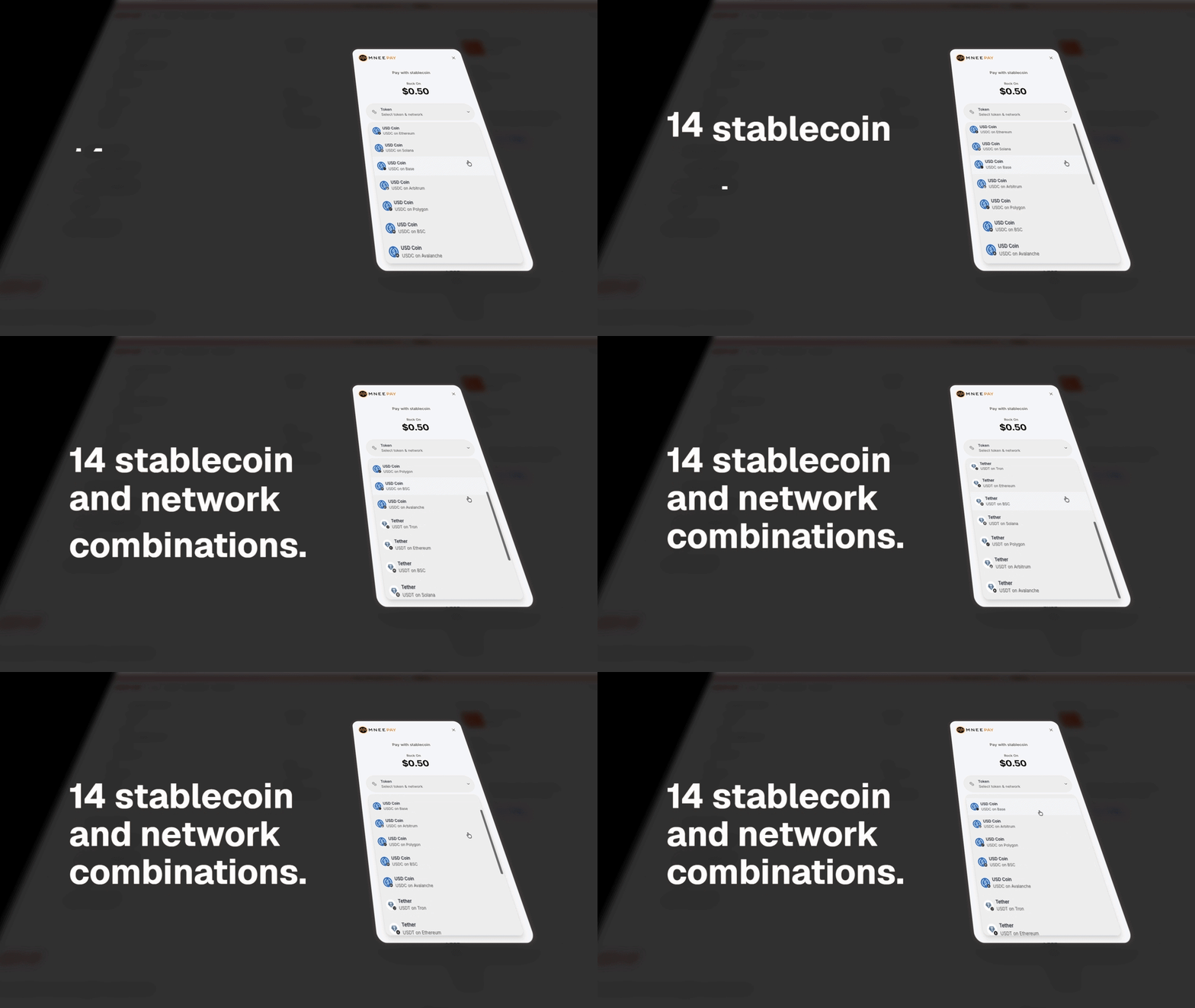
A checkout that behaves like any other. Buyers can pay with 14 stablecoin and network combinations, with no bridging or swapping needed. They pay in the token they already hold, from the wallet they already use, and the payment is received at stable value. No new account, no conversion step, no friction you have to explain later in a support ticket.
What you do not have to do
You do not touch any of the crypto mechanics. You are not watching a price chart, timing a conversion, or moving tokens between chains. The payment is denominated and received in stable value, so a $100 order is a $100 order. Your job stays what it always was: fulfill the order.
If you want to compare how this fits different storefronts, MNEE Pay breaks down three ways to accept stablecoin payments.
The sale settles: timing and the exact fee
This is the section you probably scrolled to. Two questions matter most: when do I get the money, and what does it cost?
What you pay
A flat 0.99% + $0.05 per transaction, automatically deducted at settlement. That is the whole fee. No tiers, no monthly minimum buried in a contract, no separate line items to reconcile later.
Here's a comparison between your card processor fees vs MNEE Pay:
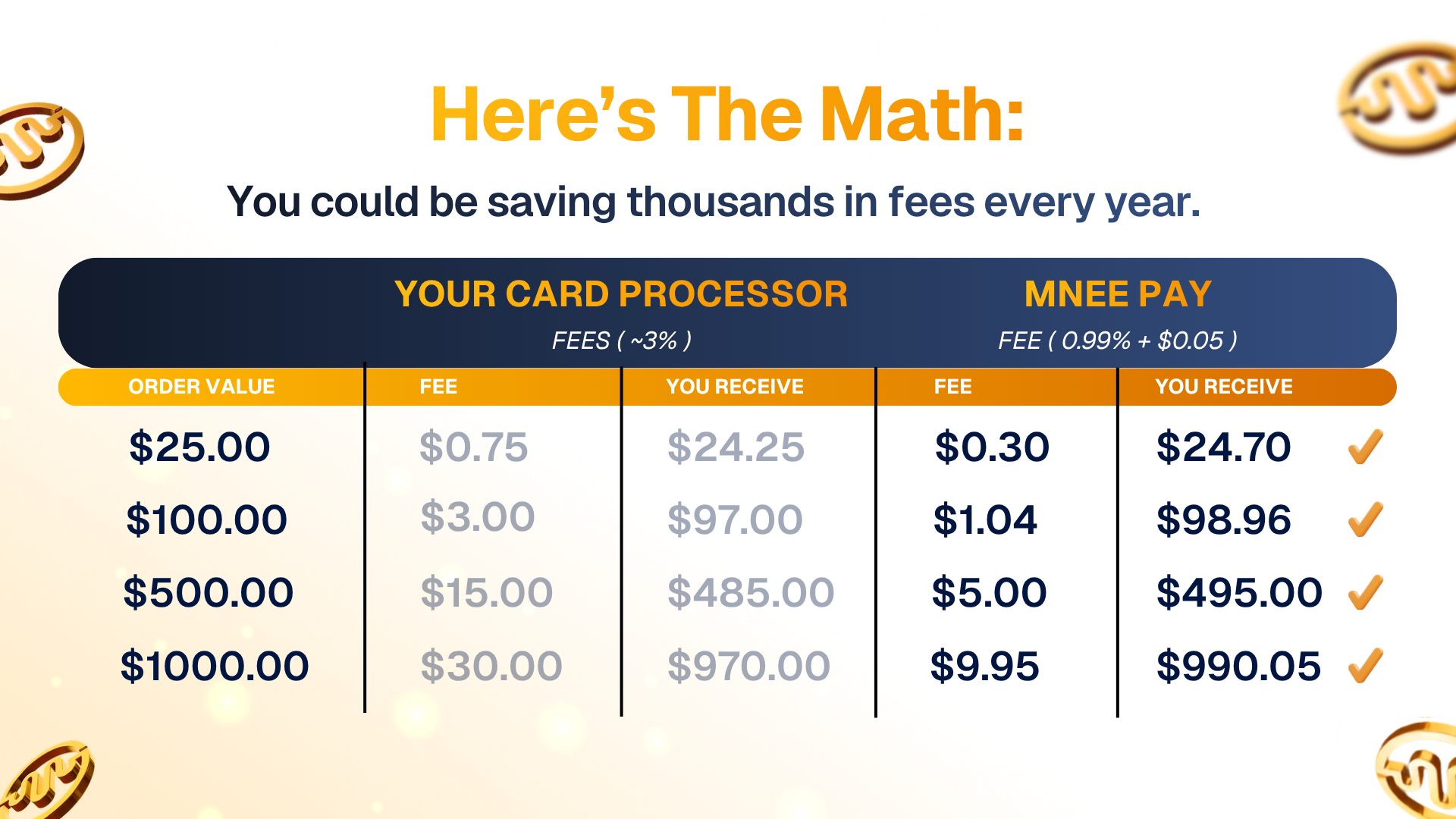
Because the fee comes out at settlement, the amount that lands in your portal is already net. There is no end-of-month invoice to reconcile against your payouts.
When funds arrive
Settlement lands directly in your Merchant Portal, ready to convert or withdraw.
Funds settle to your Merchant Portal without the multi-day wait that card processing usually involves.
If you have felt the strain of waiting on card settlement, the contrast is the whole point of why you should not have to wait 48 hours for the money you have already earned.
A refund request comes in
Refunds are where most operators expect crypto to get complicated. It does not.
Issuing a refund
Issue a full or partial refund directly from your portal. Funds return to the buyer's wallet automatically. There is no manual reversal to construct and no separate process to learn. If you can issue a refund today, you can issue this one.
Chargebacks and finality
Here is an honest tradeoff worth understanding. On-chain payments settle with finality. That means a buyer cannot file a bank chargeback against a stablecoin payment the way they can with a card. For you, that removes a common source of fraudulent reversals and the fees that come with fighting them.
It also means refunds are yours to control. When a customer deserves a refund, you send it from the portal in a full or partial amount. The buyer gets it automatically, along with a receipt.
After every payment, buyers receive a receipt with transaction details, so both sides have a clear record of what happened.
Card disputes can cost you a sale you already earned. Here's why chargebacks are broken.
End of day: reconciliation and your accountant
If a payment method makes the books harder, it is not worth it. This one is built to keep reconciliation boring, which is exactly what you want.
The record trail
Every payment produces an on-chain record and a branded buyer receipt, both visible in your portal. At close, a day of stablecoin sales reads like any other settled batch. Each transaction shows an amount, a fee, and a net figure that already matches what landed, and you can export a CSV for your accounting team.
For a closer look at how this compares to traditional systems, MNEE Pay covers refunds and payment reconciliation without complexity.
Moving balance where you need it
When you want to move a balance, convert your MNEE balance and withdraw to USDC or USDT on Ethereum directly from your portal. That covers the practical needs: paying a supplier, funding payroll, or moving working capital where your treasury wants it. It happens from the same dashboard, so there is no separate tool to log into.
How accepting stablecoin payments for e-commerce plugs into your stack
Now you might be wondering if the integration is very difficult? Can I do it myself? How much of my time does this cost to set up? Do I need to know how to code?
Alongside what you already run
MNEE Pay works with existing payment gateways, including Stripe, through a self-serve setup in the Merchant Portal. It is an added payment rail, not a migration. Your current checkout keeps running exactly as it does now, and stablecoin becomes one more way for a buyer to pay.
What setup actually takes
Setup is self-serve from the portal, with no code and no plugins. For merchants already running on Stripe, MNEE Pay can be added as a Stripe crypto payment option directly within your existing checkout flow.
Setup happens inside your MNEE Pay dashboard through a one-time configuration. Once it's live, customers can choose MNEE Pay at checkout and complete their payment using their crypto wallet. On the back end, Stripe's standard fulfillment workflows fire as normal, including receipts, shipping notifications, and any downstream automations you already have running.
You sign in and connect your Stripe account through a guided flow, a "Pay with Stablecoin" option appears at checkout alongside your existing methods, the customer pays from their wallet, and funds land in your MNEE Pay balance shown in USD, ready to withdraw.
You can see the full walkthrough on the MNEE Pay for Stripe page.
The month-end math: what it costs, what it saves
Across a month of orders, the cost is simple to model because the pricing is flat: 0.99% + $0.05 per transaction, deducted at settlement. There are no tiers to forecast and no surprises to reconcile after the fact. You can multiply your order volume by the fee and know your processing cost to the cent.
Rather than quote a savings figure that depends on your current setup, run your own numbers. Put your real monthly volume and average order value into the MNEE Pay savings calculator and see the cost side by side with what you pay today.
Going live: verification and first payment
One step happens before your first payment, and it works in your favor.
We verify your business before you go live. It protects you and your buyers. Verification confirms you are a legitimate merchant, which keeps bad actors out of the network and gives your customers a payment method they can trust. It is a one-time step, not an ongoing hurdle. If you are weighing providers, it helps to know what to ask any payments provider about security and compliance.
From there the path is short: verify your business, connect MNEE Pay to your stack, and accept your first stablecoin payment. Verify, connect, accept.
The whole day, in one line
A checkout your customers recognize. Settlement that lands net in your portal. You see balance in your Merchant Portal in a fraction of the time card settlement takes, with none of the standard T+2 delay.
Refunds you control, and a record trail your accountant can reconcile without learning anything new. That is what accepting stablecoin payments for e-commerce actually looks like day to day.
And if you are still weighing the decision, MNEE Pay addresses the five myths that hold merchants back.
FAQ
What does it cost to accept stablecoin payments for e-commerce?
A flat 0.99% + $0.05 per transaction, deducted automatically at settlement. There are no tiers and no monthly minimum. On a $100 sale the fee is $1.04, so $98.96 lands in your Merchant Portal. The amount that arrives is already net, so there is no separate invoice to reconcile against your payouts.
Do I have to replace my current checkout or payment gateway?
No. MNEE Pay runs alongside the payment methods you already offer and works with existing gateways, including Stripe, through a self-serve setup in the Merchant Portal. It is an added payment rail, not a migration. Your current checkout keeps running exactly as it does now.
Which stablecoins can buyers pay with?
Buyers can pay with 14 stablecoin and network combinations, starting with USDC and MNEE, with no bridging or swapping needed. They pay in the token they already hold, from the wallet they already use, and the payment is received at stable value. MNEE is a stablecoin always worth $1 USD, so a $100 order is a $100 order.
How do refunds and chargebacks work?
You issue a full or partial refund directly from your portal, and the funds return to the buyer's wallet automatically. On-chain payments settle with finality, so a buyer cannot file a bank chargeback the way they can with a card. That removes a common source of fraudulent reversals, while refunds stay fully in your control.
How does this reconcile at the end of the day?
Every payment produces an on-chain record and a branded buyer receipt, both visible in your portal. A day of stablecoin sales reads like any other settled batch: each transaction shows an amount, a fee, and a net figure that already matches what landed. When you want to move a balance, convert your MNEE balance and withdraw to USDC or USDT on Ethereum directly from the portal.
Do I have to verify my business before I can accept payments?
Yes, and it works in your favor. We verify your business before you go live, which protects you and your buyers by keeping bad actors out of the network. It is a one-time step, not an ongoing hurdle. From there the path is short: verify your business, connect MNEE Pay to your stack, and accept your first stablecoin payment.